English
  Spanish
  Portuguese
  Arabic
  Russian
  简体中文
简体中文 

 Location:
 Difference Between Fiber OM3 and OM4: A Comprehensive Comparison
 Update Time:2026-01-21
 Traffic:
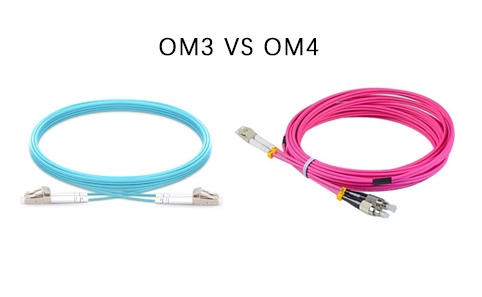
In the realm of data center and high-speed network infrastructure, optical fiber technology plays a pivotal role. Among the various types of multi-mode fibers, OM3 and OM4 stand out as popular choices for short-distance high-speed data transmission. Understanding the difference between fiber OM3 and OM4 is crucial for network professionals and IT decision-makers when selecting the appropriate fiber optic solution for their environments. This article provides a detailed comparison of these two fiber types, covering their specifications, performance, and ideal use cases.
What Are OM3 and OM4 Fibers?
OM3 and OM4 are both laser-optimized multi-mode fibers (MMF) designed for high-speed data transmission over short distances. They share a common core diameter of 50μm and are specifically optimized for use with vertical-cavity surface-emitting laser (VCSEL) light sources at 850nm wavelength. Both fiber types fall under the ISO/IEC 11801 international standard for optical fiber cables.
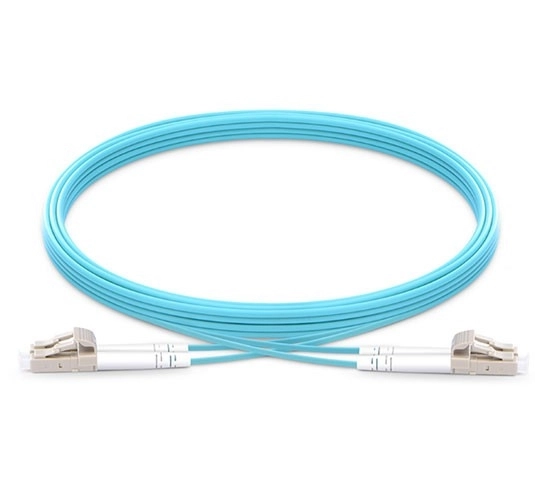
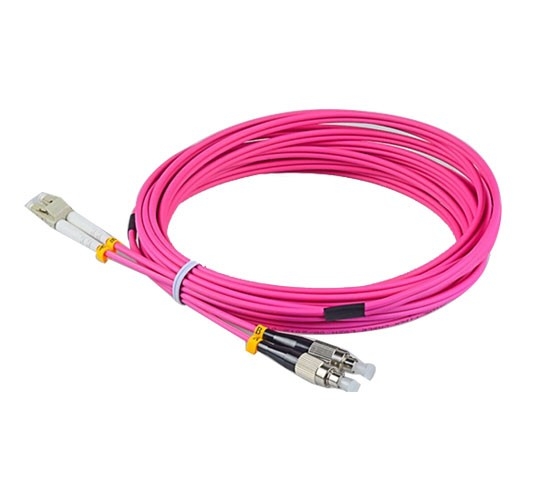
While OM3 fiber was developed to support 10 Gigabit Ethernet applications, OM4 represents an enhanced version of OM3 with improved performance characteristics. Both fiber types use water-blue colored jackets as standard, though some European and American manufacturers offer OM4 with a violet-colored jacket for differentiation.
Key Differences Between OM3 and OM4 Fibers
1. Core Specifications
Both OM3 and OM4 fibers feature:
Core diameter: 50μm
Cladding diameter: 125μm
Graded-index profile
Water-blue jacket color (standard)
The fundamental difference lies in their core composition and manufacturing process. OM4 fiber incorporates advanced materials and refined manufacturing techniques to achieve superior performance.
2. Bandwidth and Data Rate Support
OM3 Fiber : Offers an effective modal bandwidth (EMB) of 2000 MHz·km at 850nm wavelength.
OM4 Fiber : Provides an enhanced EMB of 4700 MHz·km at 850nm wavelength.
This significant difference in bandwidth translates to better performance in high-speed applications:
Both support 10Gbps, 40Gbps, and 100Gbps data rates
OM4 maintains higher signal integrity over longer distances
3. Transmission Distance Capabilities
The difference between fiber OM3 and OM4 becomes most apparent when comparing their maximum transmission distances at various data rates:
Data Rate | OM3 Max Distance | OM4 Max Distance |
1Gbps | 1 km | 1 km |
10Gbps | 300 m | 550 m |
40Gbps | 100 m | 150 m |
100Gbps | 100 m | 150 m |
OM4's extended reach makes it particularly valuable for larger data center environments where longer links between equipment are required.
4. Attenuation Characteristics
OM4 fiber demonstrates superior attenuation control compared to OM3:
OM3: 3.5 dB/km at 850nm
OM4: 3.0 dB/km at 850nm
This lower attenuation contributes to OM4's ability to maintain signal quality over longer distances.
5. Price Comparison
The difference between fiber OM3 and OM4 in cost is significant:
OM4 fiber typically costs about twice as much as OM3
Price ranges for OM3: 9−9−600 per unit
Price ranges for OM4: 11−11−640 per unit
While OM4 is more expensive, its performance advantages often justify the cost in demanding applications.
Performance Comparison in Real-world Scenarios
1. 10Gbps Ethernet Applications
OM3: Maximum distance of 300 meters
OM4: Can reach up to 550 meters
Advantage: OM4 provides nearly double the reach for 10G connections
2. 40Gbps and 100Gbps Applications
Both support these high speeds through MPO connectors
OM3: Limited to 100 meters
OM4: Extends to 150 meters
Benefit: OM4 allows for more flexible data center layout options
3. Future-proofing Considerations
OM4 fiber offers better future-proofing for several reasons:
Supports higher data rates with better performance
More compatible with upcoming technologies
Provides headroom for network expansion
When to Choose OM3 vs. OM4
Ideal Applications for OM3 Fiber
Small to medium-sized data centers
Enterprise networks with shorter reach requirements
Existing installations where cost is a primary concern
Applications where 300m reach for 10G is sufficient
Recommended Applications for OM4 Fiber
Large-scale data centers requiring longer links
High-performance computing environments
Financial institutions with low-latency requirements
Networks anticipating future upgrades to higher speeds
Environments where maximum reach is critical
The difference between fiber OM3 and OM4 lies in their performance characteristics, with OM4 offering superior bandwidth, longer reach, and better future-proofing capabilities. While OM3 remains a cost-effective solution for many applications, OM4's enhanced performance makes it the preferred choice for demanding high-speed environments and large-scale installations.
When selecting between these two fiber types, network professionals should carefully evaluate their specific requirements, considering factors such as current needs, future expansion plans, and budget constraints. Understanding these differences ensures optimal network performance and cost efficiency in today's data-intensive world.