
Blog
blog Location: Home > Blog > Technical Article
 Why is indoor fiber optic cable more expensive than outdoor fiber optic cable?
Optical cable: The center of an optical fiber is usually a core made of glass. The core is surrounded by a glass envelope with a lower refractive index than the core, so that the optical signal incident on the core is reflected through the cladding interface, so that the optical signal propagates
 Does a pre-terminated cable have to be in the data center? MPO Pre-terminated Ca
Does pre-terminated cable have to be in the data center? MPO pre-terminated cable system solutions Pre-terminated cables are not necessarily used in data centers, but can also be used in other places. Pre-terminated cables have the characteristics of high transmission rate, transmission safe
Analysis of the Reasons for Color Differentiation of Fiber Sheath
The differences in fiber sheath colors (e.g. black, white) are mainly due to the requirements of industry standards, application scenarios, and technical specifications. The following are the specific reasons: 1. Industry standards and labels Organizations such as the International Telecommunica
Pure copper vs oxygen-free copper network cable: analysis of core differences
The differences between pure copper (Electrolytic Copper) and oxygen-free copper (Oxygen-Free Copper, OFC) network wires are mainly reflected in material purity, electrical conductivity, and durability. The specific differences are as follows: 1. Material purity Pure copper: Extracted by electro
What is the function of the 6 types of unshielded water-blocking network cables?
Category 6 unshielded water-blocking network cable is a network transmission medium that combines the transmission performance of Category 6 network cable, the flexibility of unshielded structure, and the characteristics of water-blocking protection. Its functions are mainly reflected in the follo
Can multi-core wires be used for comprehensive wiring of fire weak current syste
In the comprehensive wiring of fire protection weak current systems, multi-core wires can be used, but they need to be selected according to specific scenarios and specifications. The following is the detailed answer: First, the applicability of multi-core wires Advantage: Anti-interference abi
Network cable category recognition strategy: from skin identification to profess
First, quick identification method: check the outer skin logo The outer skin of the network cable is usually printed with a clear category logo, which is the most direct and fastest way to judge: Category 5 network cable: Identified as CAT5, suitable for 100Mbps network, with a maximum transmiss
A Guide to the Truth and Identification of "Cat6e" Cables
The true identity of the Cat6e cable The Cat6e cable is a type of Super Category 6 cable, an enhanced version of Category 6 cable (Cat6), designed for 10 Gigabit networks. Its core technical indicators include: Transmission rate: Supports up to 10Gbps (much higher than the 1Gbps of the ordinary
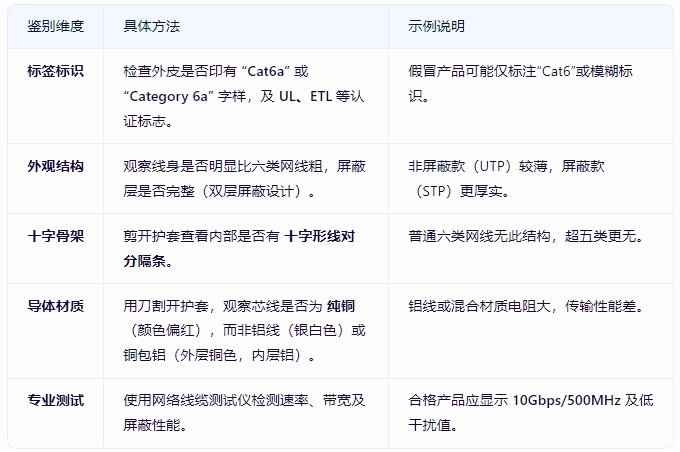 Super six network cable identification and purchase guide
First, the core characteristics of super six network cables transmission performance Speed and bandwidth: Support up to 10Gbps transmission rate, with a frequency bandwidth of 500MHz (some standards support higher), far exceeding the 1Gbps/250MHz of ordinary Category 6 network cables. Transmiss
Detailed explanation of pre-connected OM4 fiber distribution frame
First, OM4 fiber optic distribution frame foundation analysis Definition and characteristics High bandwidth support: OM4 fiber is designed for short-distance, high-bandwidth transmission, supporting up to 100Gbps (commonly used 40Gbps), with a bandwidth of 4700 MHz · km, far exceeding OM3‘s 2000

 English
  Spanish
  Portuguese
  Arabic
  Russian
  简体中文
简体中文